7 hr
Naples: Pompeii & Herculaneum Archaeologist-Led Tour
- Expert local guide
- Small group
- Skip-the-line access
- Free cancellation
Pompeii And Herculaneum Tour — Guided Access to Two Buried Cities
Ash sealed their streets, time reopened their doors.
Compare fares, pick the fit — all bookings are mobile-voucher and eligible for free cancellation where shown.
7 hr
5 hr 30 min
5 hr
Worth it for anyone who values ancient history
At 18 EUR adult entry, a pompeii and herculaneum tour delivers rare value for the scale involved. That single fee opens roughly 44 hectares of excavated Roman city: paved streets rutted by cart wheels, frescoed villas, the Forum, bathhouses, an amphitheatre, and plaster casts of the eruption's victims. Few archaeological sites anywhere pack this much intact daily life into one ticket, and the density of standing structures makes the Pompeii ruins tour rewarding whether you spend two hours or five. The value pays off best for first-time visitors, history enthusiasts, and slow walkers who want to wander. It pays off less for anyone expecting quick highlights, since covering the ground demands stamina under open sun. Skip-the-line Pompeii tickets ease the entry queue but not the walking. Weighed against comparable European landmarks charging more for less, the 18 EUR sits firmly on the worthwhile side.
Bottom line: For 18 EUR, a well-planned pompeii and herculaneum tour tour repays the fee many times over for anyone with genuine curiosity and decent stamina.
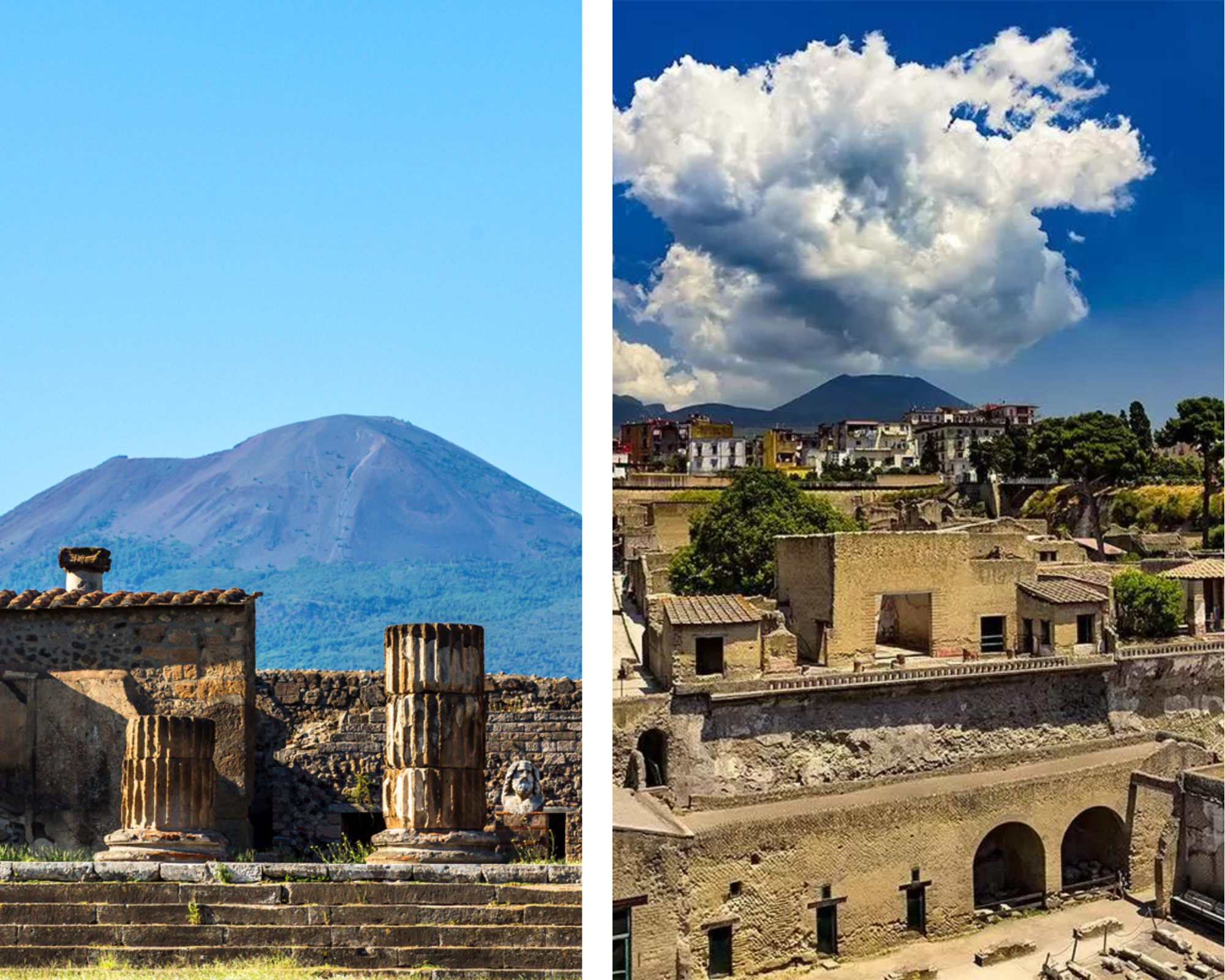
Most travelers weighing a pompeii and herculaneum tour against a Herculaneum-only visit find the answer comes down to time budget: a single full day favors Pompeii's scale, while a half-day favors Herculaneum's preservation.
|
Top pick Pompeii |
Herculaneum (Ercolano) | |
|---|---|---|
| Site size and walking distance | 66 hectares, 2–3 miles of paths | 4.5 hectares, under 1 mile |
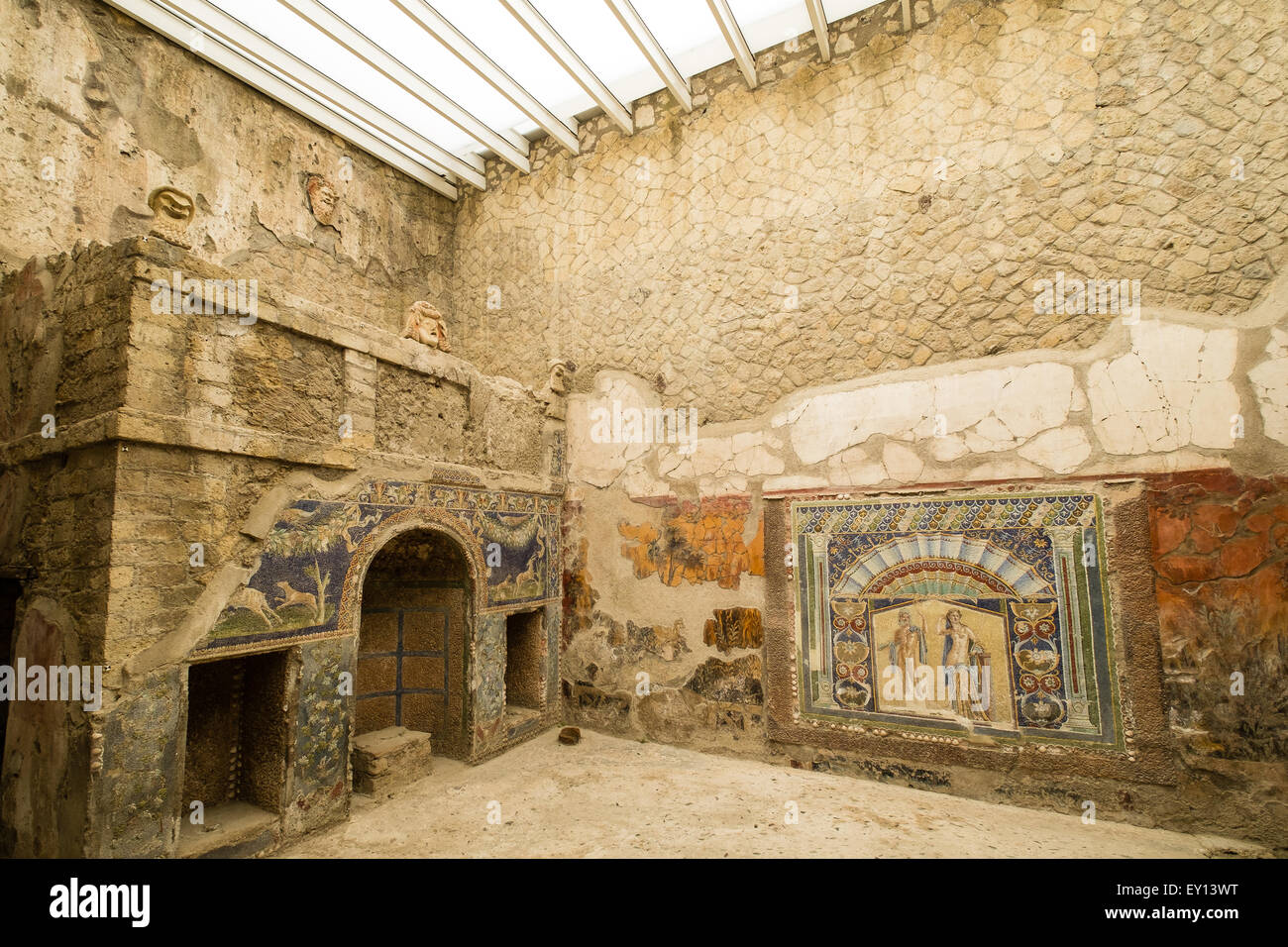
| Preservation style | Ash burial, upper floors mostly lost | Pyroclastic surge, wood and 2nd floors survive |
| Typical visit duration | 3–6 hours | 1.5–2.5 hours |
| Crowd levels | 8,000–20,000 daily visitors, busy midday | 1,500–3,000 daily visitors, quieter |
| What each site is best for | Forum, amphitheater, full Roman city scale | Intact houses, frescoes, carbonized wood |
| Getting there from Naples | Circumvesuviana train, ~35–40 minutes | Circumvesuviana train, ~20–25 minutes |
| See tickets & prices |
Verdict: Choose Pompeii-only if you have one day and want scale and iconic landmarks; add Herculaneum, or pick it alone, if preservation detail and lighter crowds matter more than size.
Hand-picked experiences loved by thousands of travelers
11 hours
Free Cancellation
Explore ancient ruins on this comprehensive day tour from Rome featuring expert-led walks in Pompeii and Herculaneum.
5 hours
Free Cancellation
Uncover Roman history with a private archaeological guide on this flexible, skip-the-line 5-hour double-city tour.
8 hours
Free Cancellation
Discover the preserved remains of two UNESCO World Heritage sites on this guided day trip including lunch and transport.
Enter through the western gate near Pompei Scavi station and collect a site map
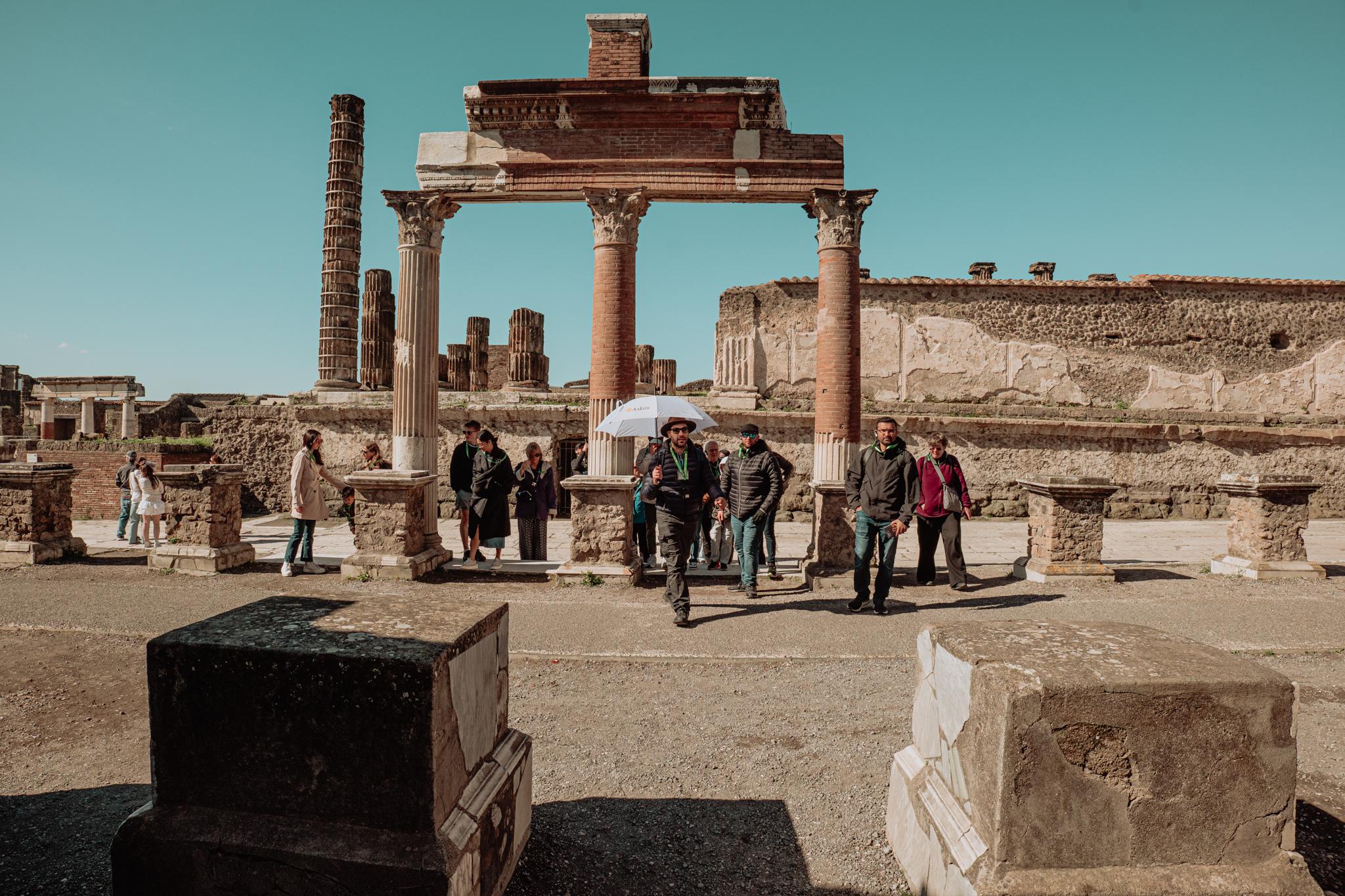
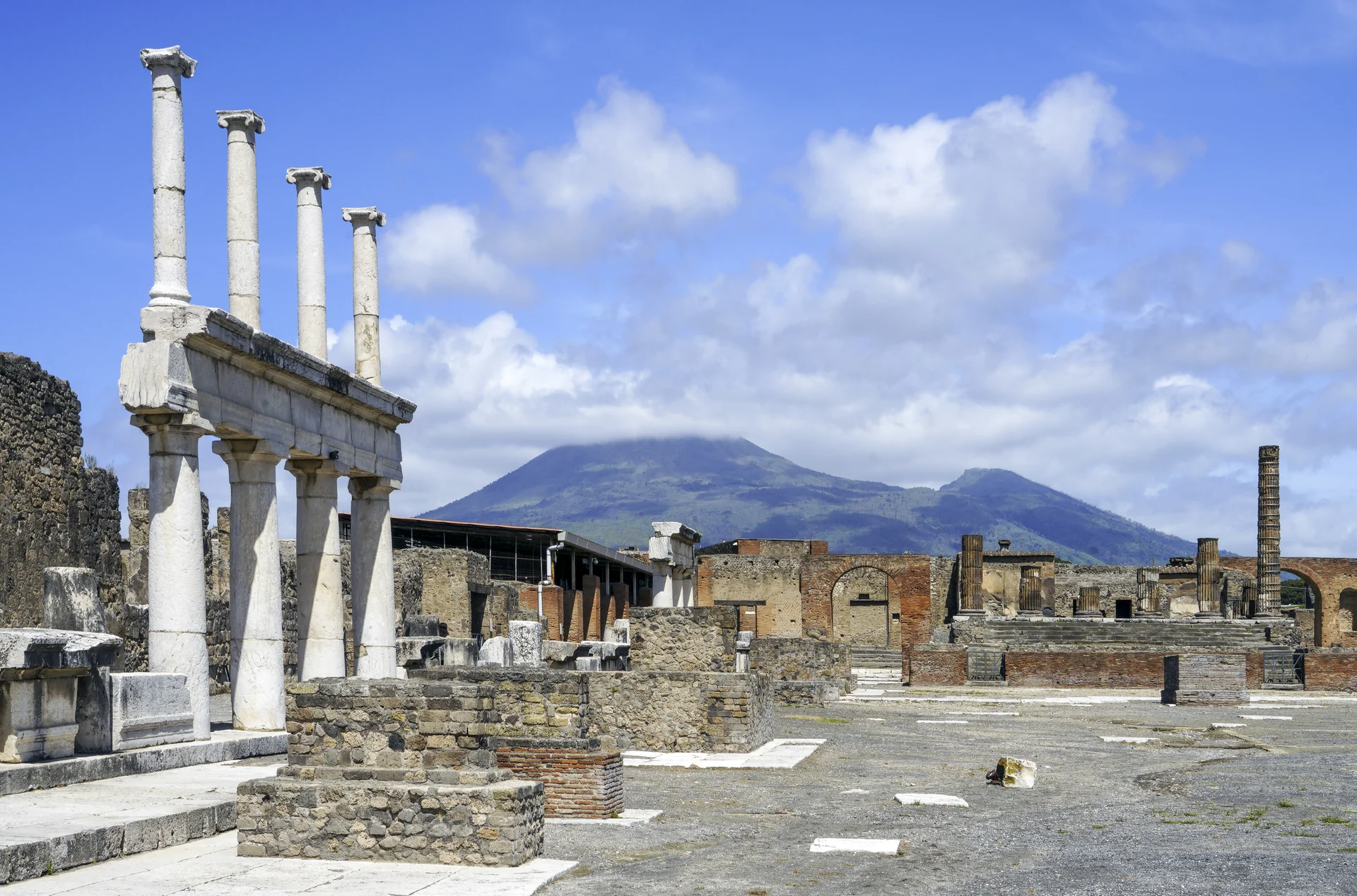
Orient yourself in the civic and religious heart, with Vesuvius framed behind the Temple of Jupiter
View the replica dancing faun statue and the mosaic-floored courtyard of the city's grandest residence
See original brothel frescoes, then the haunting plaster casts of eruption victims
Walk the oldest surviving Roman stone amphitheatre, built around 70 BCE
Finish with the Dionysiac fresco cycle on the site's northern edge, near the second train station exit
The civic and religious heart of Pompeii, framed by a direct sightline to Mount Vesuvius beyond the Temple of Jupiter. It was the site of markets, elections, and public speeches for a city of an estimated 11,000 residents before 79 CE.
A suburban villa on the northern edge of the site holding the most complete cycle of Roman wall paintings in existence, showing 29 near-life-size figures in a Dionysiac initiation rite. Its working wine-press room still contains a partially preserved original wooden press.
The largest private residence excavated at Pompeii, named for the bronze dancing faun statue found in its central courtyard, now replaced there by a replica. Its floor once held the Alexander Mosaic, a scene over 5 meters wide now preserved in the Naples Archaeological Museum.
Built around 70 BCE, it ranks among the oldest surviving Roman stone amphitheatres in the world and once held roughly 20,000 spectators for gladiatorial contests. A riot between Pompeian and Nucerian fans here in 59 CE led Emperor Nero to ban games at the venue for a decade.
A vineyard-turned-burial site displaying plaster casts of 13 victims who died together while fleeing the eruption, made by pouring plaster into cavities left by decomposed bodies in the hardened ash. The casts capture postures frozen at the final moment of the disaster.
The best-preserved ancient brothel at the site, identifiable by stone platform beds and small erotic frescoes above each cubicle believed to have advertised services. Graffiti scratched into its walls by visitors nearly 2,000 years ago still survives on the plaster.
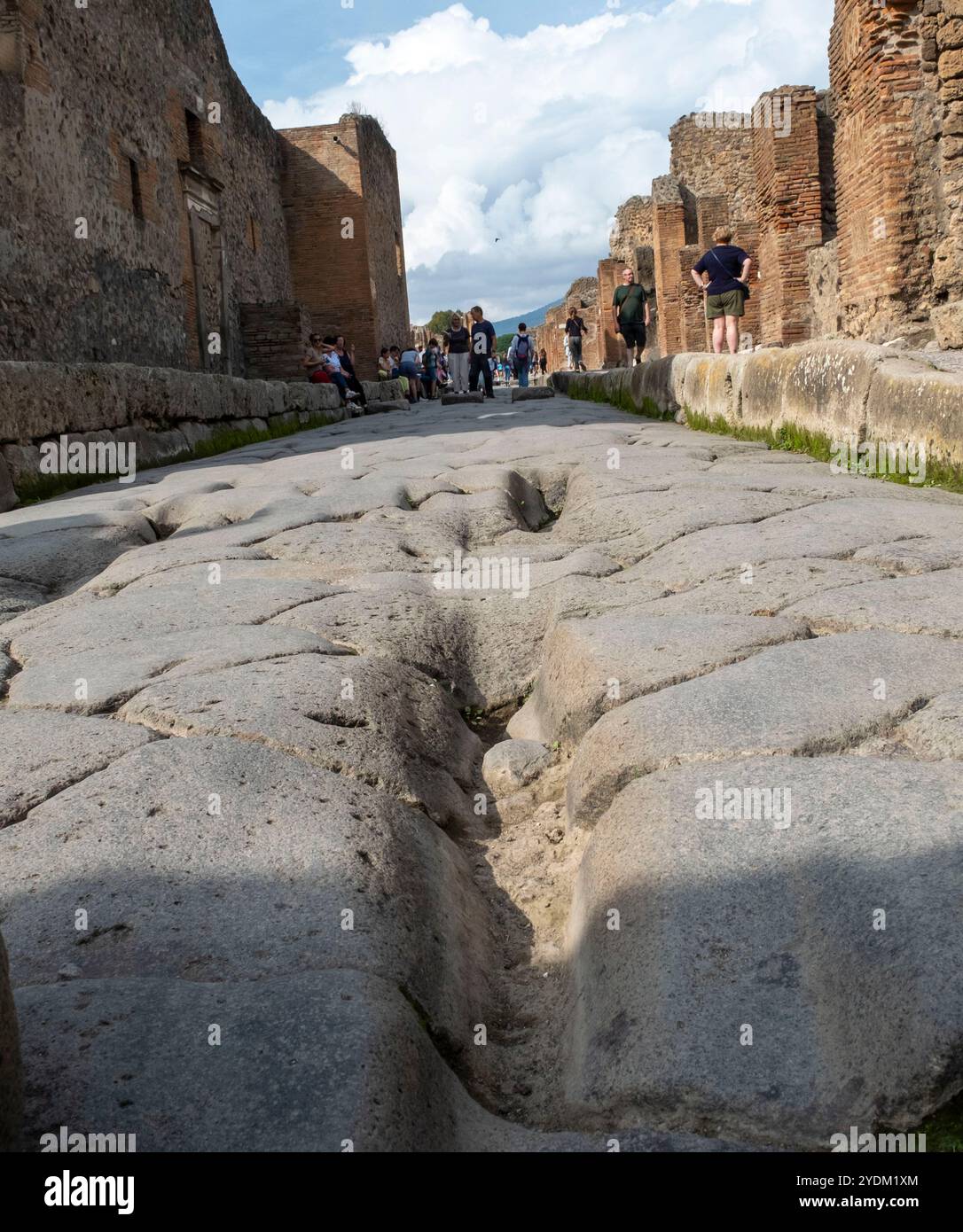
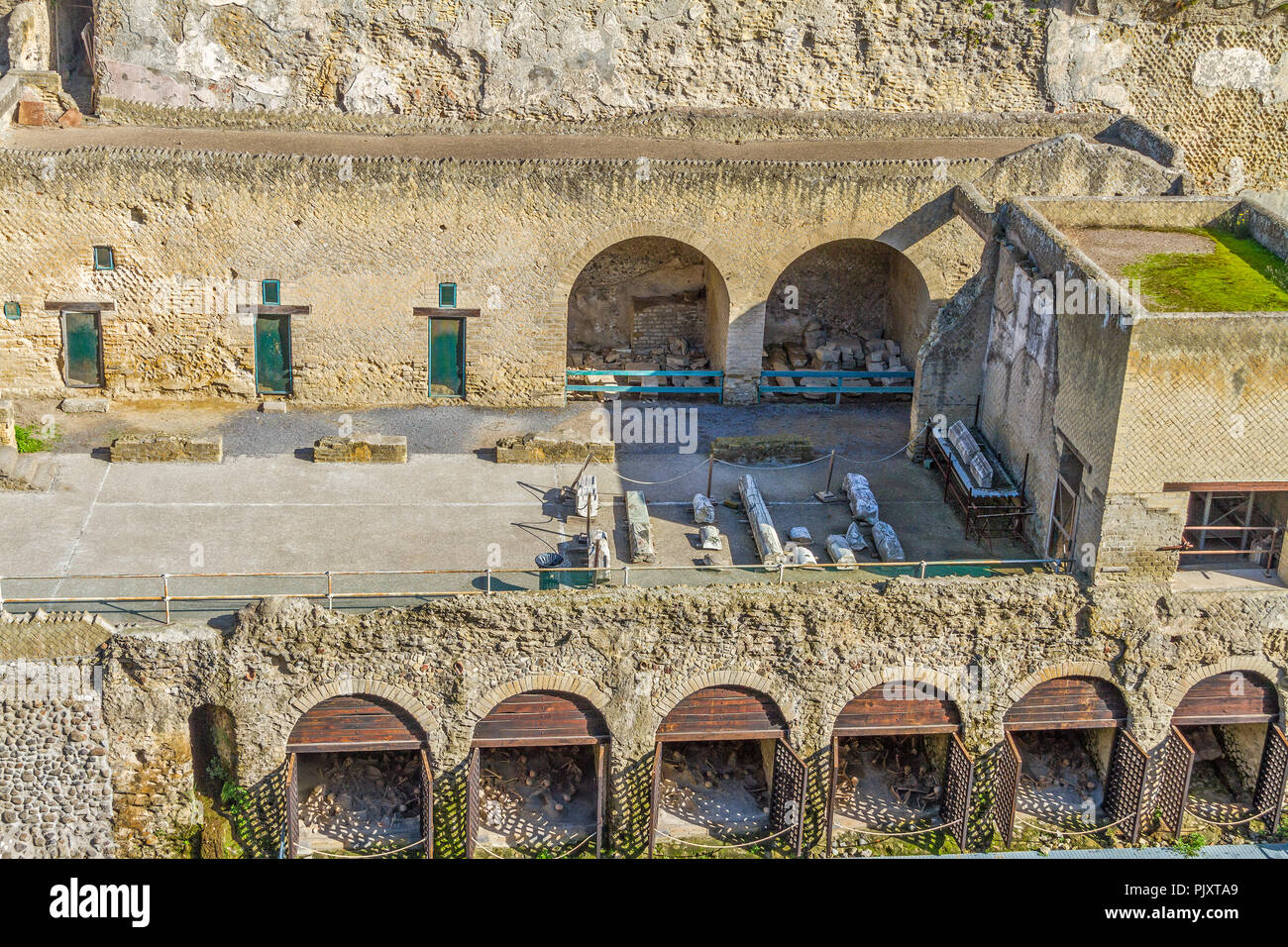
You enter through the Porta Marina gate and the modern world falls away within a few paces. Your first steps land on basalt stones grooved by centuries of cart traffic, and you feel the ancient camber underfoot before you reach the Forum, where columns frame Vesuvius on the northern horizon. You turn into a side lane and the scale shifts to the domestic. You pause at a bakery's blackened oven, then at a thermopolium counter where jars once held hot food for passing workers. In the Villa dei Misteri you stand close to frescoes whose red still saturates the plaster, the figures almost breathing at eye level. By midday you transfer the short distance toward the coast to Herculaneum, and the ruins change character. Here you descend into streets that sit below the modern town, and you climb intact wooden staircases and pass carbonised beams that Pompeii never kept. You lean over a boat house and consider the skeletons found sheltering there. A good pompeii and herculaneum tour lets you move at a human pace across both sites in one day, trading the sprawl of one city for the vertical intimacy of the other before you climb back into daylight.
All the details about your upcoming adventure in one place
A pompeii and herculaneum tour pairs two of Campania's best-preserved archaeological parks, tracing Roman streets, frescoed villas, and forum ruins beneath Vesuvius. Led by licensed local guides, these excursions bring the ancient towns' bathhouses, mosaics, and plaster casts into clear focus. Booking pompeii and herculaneum tour tickets in advance secures entry and pairs you with a small-group archaeologist for context along the way.
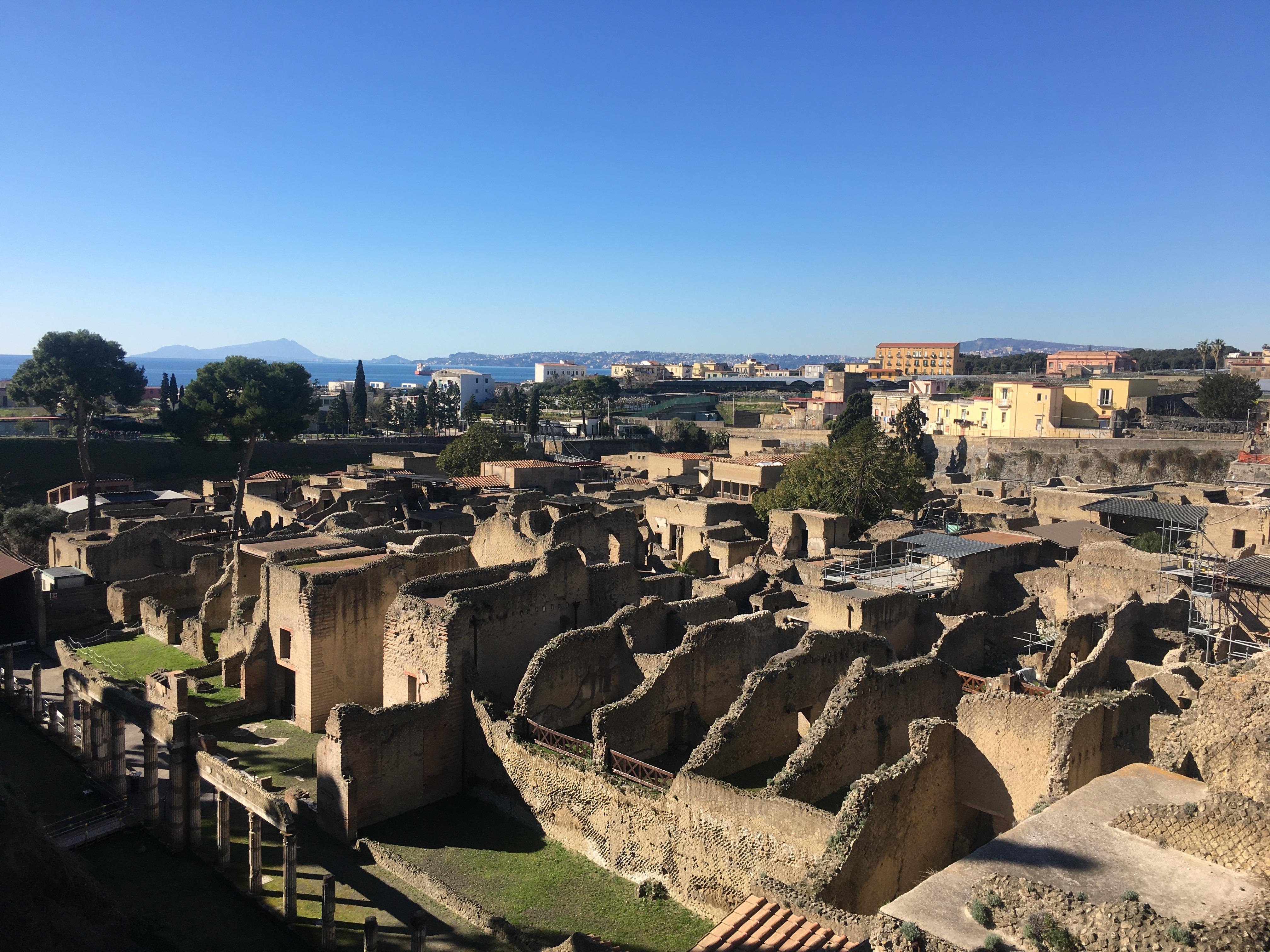
The eruption of Vesuvius in AD 79 buried Pompeii under roughly six metres of pumice and ash in a single afternoon, and it stopped a Roman city mid-gesture. Loaves of bread sat in ovens. Election slogans still marked the walls. A pompeii and herculaneum tour begins from this improbable fact: that catastrophe became a form of preservation no other ancient site can rival. Pompeii was a prosperous provincial town of perhaps 12,000 people, a hub of commerce along the Sarno river with a forum, an amphitheatre seating 20,000, and two theatres. Herculaneum, smaller and wealthier, sat closer to the volcano and was sealed instead by superheated pyroclastic surges that carbonised wood, food, and even papyrus scrolls. The contrast between the two towns is why they are so often studied together and why so many tour di Pompei ed Ercolano itineraries pair them. What survives is a cross-section of daily Roman life rendered in astonishing texture. Frescoes in the Villa dei Misteri still hold their Pompeian red, their figures moving through a rite scholars still debate. Mosaic floors spell out cave canem — beware of the dog — at the thresholds of merchant houses. Bakeries retain their millstones; wine bars, the terracotta jars sunk into their marble counters. The plaster casts, made by pouring liquid into the voids left by decomposed bodies, capture posture and grief with a directness that unsettles every generation that encounters them. The two sites together form one of the most complete records of the classical world, jointly inscribed as a UNESCO World Heritage property since 1997. Herculaneum's upper storeys, wooden balconies, and intact staircases show what Pompeii lost to depth and time; Pompeii's scale shows what Herculaneum's compact footprint cannot. Ongoing excavation continues to surface new rooms and inscriptions, and a well-planned pompeii and herculaneum tour tour threads these discoveries into a single narrative of a landscape the Romans called Campania Felix, the fortunate country. They mattered to eighteenth-century Europe, whose Grand Tourists sketched the ruins and carried a neoclassical fashion home. They matter now as an archaeological laboratory, where soil analysis, DNA study, and conservation science refine what a wall painting or a carbonised fig can tell us. To walk the basalt-paved streets, still grooved by cart wheels, is to read a legible city rather than a picturesque ruin — the reason interest in pompeii and herculaneum tour tours has never faded across two and a half centuries of visitors.
Catastrophe became a form of preservation no other ancient site can rival.
Wear closed, sturdy shoes for uneven volcanic stone paving and ankle-turning gaps between the original Roman flagstones. Bring a hat and light, breathable clothing, since almost the entire Pompeii Archaeological Park is unshaded open ground. Shoulders and knees don't need to be covered here, unlike at some churches nearby, but sun protection is essential on a pompeii and herculaneum tour in summer.
All visitors pass through a security screening at the entrance gates, and bags larger than roughly 30 x 30 x 15 cm must be checked at the cloakroom near Porta Marina. Staff may ask to see a valid identity document alongside your ticket, so keep both accessible when joining any pompeii and herculaneum tour tour group.
Personal, non-flash photography is permitted throughout the excavated streets, houses, and the Amphitheatre. Flash is discouraged near frescoes in structures like the Villa of the Mysteries and House of the Vettii, where pigments are light-sensitive, and tripods generally require prior authorization from the park.
Children under 18 from EU member states enter free, and the Garden of the Fugitives plaster casts tend to hold young visitors' attention. Strollers manage the main thoroughfares but struggle on narrower side lanes with raised stepping stones.
The main route from Porta Marina along Via dell'Abbondanza is paved and wheelchair-friendly, with an accessibility map available at the entrance kiosk. Several side streets and house interiors retain original stepped thresholds and uneven volcanic stone that limit full wheelchair access across the site.
Outside food may be eaten only in designated picnic areas marked on the official park map, not inside the houses or temples. Bottled water and light snacks are sold at on-site kiosks, and refillable bottles can be topped up at public fountains along the main streets.
Quiet after 09:00 opening rush
Midweek, generally lighter crowds
Busier ahead of the weekend
Cruise-group peak afternoons
First Sunday of month is free entry
Hours
Open daily 09:00–19:00
Public transport · 35-40 min from Naples · Approx 3-4 EUR one-way
Take the Circumvesuviana train from Napoli Garibaldi to Pompei Scavi - Villa dei Misteri station, which sits roughly 100 meters from the Porta Marina entrance
Car · 30-40 min from Naples · Parking approx 5-10 EUR
Follow the A3 motorway from Naples toward Salerno and take the Pompei exit, then follow signs to the archaeological park's paid car parks near Porta Marina
Taxi · 35-50 min depending on origin · Approx 60-90 EUR from Naples
Direct taxis from central Naples or Sorrento drop passengers at the Porta Marina or Piazza Anfiteatro gates
Walk · 2-3 min from station · Free
From Pompei Scavi - Villa dei Misteri station it is a short level walk directly to the main entrance turnstiles
Most bookings for a pompeii and herculaneum tour can be cancelled up to 24 hours before the scheduled start for a full refund; the 18 EUR Pompeii Archaeological Park entry fee itself is non-refundable once a timed slot has been used. Tour operators combining both sites typically apply the same 24-hour window for date changes.
Recommended time
3-4 hours (up to 6 for a thorough visit)
A focused 2-hour loop covers the Forum, Amphitheatre, and a few frescoed houses, while 3-4 hours is the realistic middle ground for most people doing a pompeii and herculaneum tour, and 5-6 hours suits history buffs who want the quieter side streets and Villa of the Mysteries too. Add 30-60 minutes in midsummer for shade breaks and water stops, and subtract time if you're doing a tightly guided skip-the-line pompeii tour rather than exploring solo. Queues at the ticket booths build fast once coach groups and cruise-ship arrivals land, so the 09:00-11:00 window stays your best shot at open paths through the Forum before the site fills in. Booking pompeii and herculaneum tour tickets ahead avoids the worst of the counter line entirely.
Crowd levels through the day
Weather · crowds · average price — dots go green to amber to red as each metric rises.
April and May bring mild 18-24°C days and blooming Mediterranean vegetation along the ruins, with moderate crowds before the summer surge. Shoulder-season light also favors photography of the Forum colonnades.
June through August sees temperatures regularly above 30°C with little shade across the 66-hectare park, plus peak cruise-ship and school-holiday crowds. A pompeii and herculaneum tour in high summer rewards early booking and an early start.
September and October offer warm but manageable weather in the low-to-mid 20s°C, with crowds thinning noticeably after the first week of September. This is often considered the most comfortable season for a full day exploring both Pompeii and Herculaneum.
November through March is coolest and quietest, with occasional rain and hours ending at 17:00 rather than 19:00 outside summer months. Fewer tour groups make it easier to linger inside frescoed houses like the Villa of the Mysteries.
Pre-purchase a dated slot through the official Vivaticket channel to skip ticket-office lines that can run 45-90 minutes in peak season.
Public fountains are spaced along the main streets, so a refillable bottle avoids repeated kiosk purchases across the 66-hectare site.
The original volcanic stone paving and stepping stones are uneven, and ankle support matters more here than on a typical city walking tour.
The park limits entries to 20,000 visitors a day, with 15,000 morning slots and 5,000 afternoon slots during high season, so plan ticket timing accordingly.
A pompeii and herculaneum tour ticket bought as a combined pass can include free entry to smaller nearby sites within 30 days, worth checking before buying separate tickets.
This entrance sees lighter foot traffic than Porta Marina on days when cruise groups dominate the main gate.
Marked picnic areas near the Forum and Large Palaestra are the only spots where outside food is permitted inside the walls.
Via Villa dei Misteri 2, 80045 Pompei, Naples, Italy
Main gate, closest to Pompei Scavi - Villa dei Misteri train station
Get directionsPiazza Anfiteatro, 80045 Pompei, Naples, Italy
Secondary gate near the Amphitheatre, convenient for groups arriving by coach
Get directionsPiazza Esedra, 80045 Pompei, Naples, Italy
Smaller gate, typically shorter queues in peak season
Get directionsOn 24 August 79 AD, or by some readings a late-October date, Vesuvius broke open. Pliny the Younger, writing to Tacitus, described the column of ash rising like an umbrella pine. Within hours, pumice buried Pompeii. Pyroclastic surges finished the work overnight. The city vanished beneath roughly six metres of volcanic debris. Pliny the Elder, commanding the fleet at Misenum, died attempting rescue at Stabiae. The site slept for centuries. In 1592, the architect Domenico Fontana cut a water channel through the buried town without recognising it. Formal digging began under Bourbon patronage in 1748, ordered by Charles III of Naples. Early work was little more than treasure-hunting. Frescoes and bronzes were prised out and carried to royal collections. Any serious pompeii and herculaneum tour today owes its route to that first chaotic decade of tunnelling. Method arrived later. From 1863, Giuseppe Fiorelli imposed a numbered regio-insula grid and excavated stratum by stratum. His plaster-cast technique, pouring liquid gypsum into the voids left by decayed bodies, recovered the human forms now central to the visitor experience. The Villa dei Misteri, with its second-style frescoes, emerged in 1909–1910. Bombing in 1943 damaged several structures. A UNESCO listing followed in 1997, and the Great Pompeii Project, launched around 2012, arrested decades of collapse and neglect. Excavation continues. Recent work in Regio V, ongoing since 2018, has uncovered painted thermopolia and fresh victim casts. What a Pompeii archaeological park tour reveals is therefore never fixed. The forum, the amphitheatre of 70 BC, the lupanar, and the cast-filled Garden of the Fugitives all reflect layers of interpretation added across three centuries. Visitors weighing pompeii and herculaneum tour tickets are stepping into a working excavation, not a finished museum. Guided pompeii and herculaneum tour tours trace both Roman daily life and the archaeologists who reconstructed it. A single well-planned pompeii and herculaneum tour tour connects Fiorelli's grid, Fontana's accidental channel, and the buried streets that keep yielding evidence.
An earthquake severely damaged Pompeii, and rebuilding was still underway when Vesuvius erupted.
Vesuvius buried Pompeii under volcanic ash, recorded in Pliny the Younger's letters to Tacitus.
Domenico Fontana cut a channel through the buried city without identifying it.
Bourbon excavations began under Charles III of Naples, initially as treasure-hunting.
Giuseppe Fiorelli introduced stratigraphic method and the plaster-casting of victims.
The Villa dei Misteri and its second-style frescoes were excavated.
Pompeii was inscribed on the UNESCO World Heritage list.
Regio V excavations revealed new frescoes, inscriptions, and further body casts.
Stand at the north end of the Forum, near the Temple of Jupiter, and frame the broken columns with Vesuvius rising directly behind them. This is the single most photographed line-up in the ancient city and works equally well as a wide shot or a tight column silhouette against the volcano.
In Regio I, near the Piazza Anfiteatro entrance, a long glass case along the back wall holds the plaster casts of thirteen victims caught mid-flight during the eruption. Shoot straight on through the glass for a documentary-style frame, or angle low for a more intimate close-up on a single figure; many visitors join a guided pompeii and herculaneum tour specifically to reach this spot with context from a local guide.
The House of the Faun's grand peristyle and atrium still show the mosaic-paved floors where the Alexander Mosaic was found; the original mosaic now lives in the Naples Archaeological Museum, so the in-situ floor and the Dancing Faun statue replica are the shootable elements here. Kneel at floor level along the colonnade for a raking-light shot across the geometric tile work.
A short walk outside the city walls, this single room holds a nearly continuous red-ground fresco cycle wrapping three walls, believed to depict a Dionysian initiation rite. Stand in the center of the room and pan slowly to capture the frieze's full width in even, indirect light.
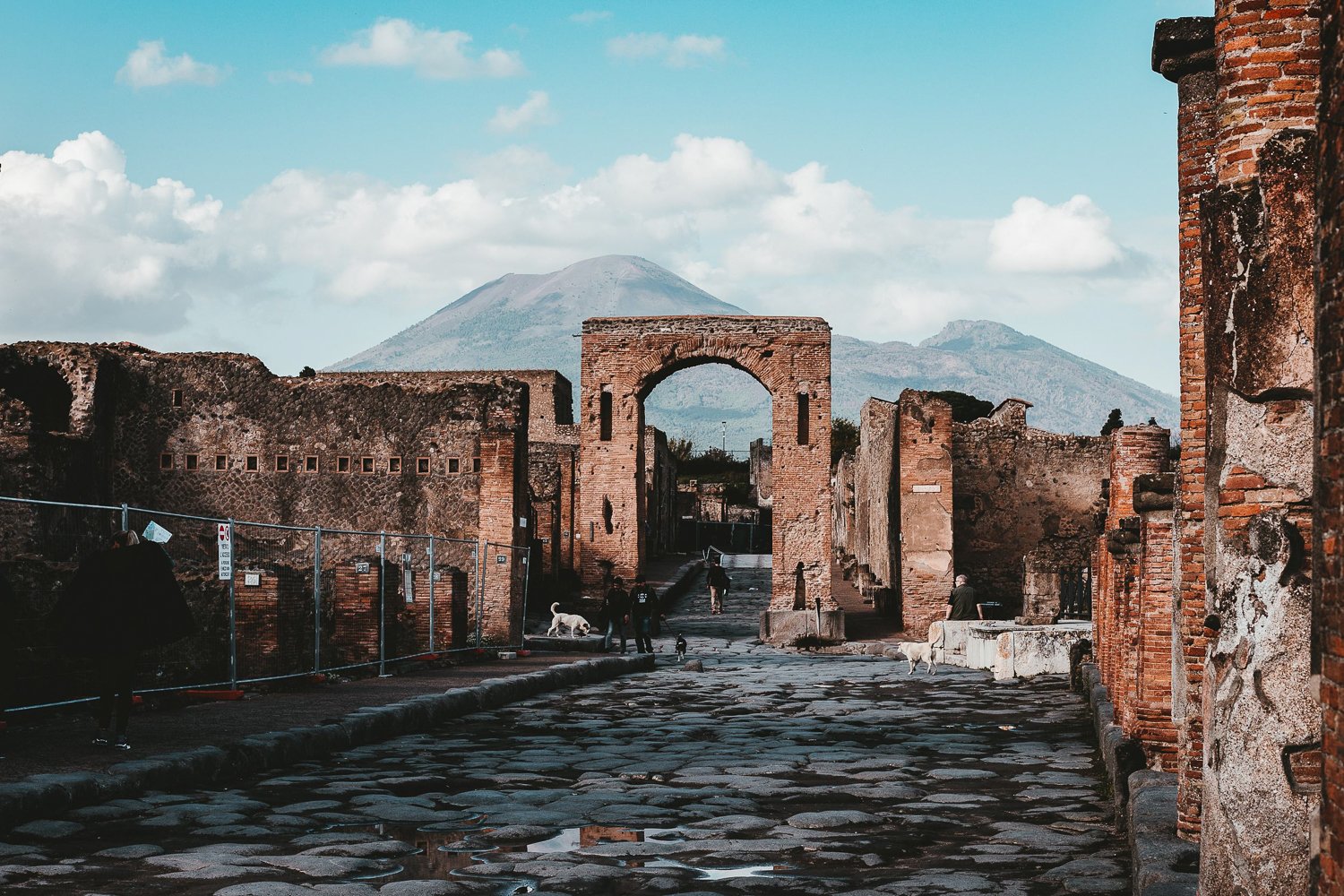
Pompeii's main commercial street stretches long and straight, lined with shopfronts, stepping stones, and wheel-rutted paving. Shoot from ground level looking down the street's vanishing point for classic depth, or crouch at a pedestrian crossing stone for a close foreground detail.
A pompeii and herculaneum tour turns ancient streets into an open-air adventure for kids, though the site's scale and heat call for a paced approach rather than a rushed march through every ruin. Families who plan around shade, water breaks, and a few standout stops tend to fare best.
Cobbled roads and steps make most of the 66-hectare park impractical for wheels; a baby carrier is easier, with the accessible "Pompeii for All" path linking Piazza Anfiteatro to Porta Marina if you do bring a pushchair.
Kids around 6 and up engage best once they can walk long distances and grasp the eruption story; toddlers manage in a carrier for shorter loops.
Baby Points near the entrances offer private changing and feeding spaces, and toilets are scattered at Piazza Esedra, Piazza Anfiteatro, and Porta Marina.
Split the visit into two loops with a sit-down break between them, saving the amphitheatre and plaster body casts for when energy dips, since both reliably re-engage tired kids; duck into shaded courtyards often, since open forum areas offer little relief from summer sun.
Little of the site is covered, so a wet visit means ducking under building overhangs between stops and keeping the pace flexible rather than sticking to a fixed loop.
Food options in the Pompeii Archaeological Park are limited by design, so most people visiting on a pompeii and herculaneum tour plan a single stop rather than grazing all day, and it pays to eat before or after the busiest ruins rather than mid-route.
Tucked behind the Temple of Jupiter, this is the park's main refreshment stop: coffee from around €2, pizza and focaccia up to about €9.50, plus charcuterie, wine, and ice cream. It gets packed between 12:30 and 14:00 when tour buses and cruise groups cluster here, so an early or late lunch works better
A quick-service kiosk right at Porta Marina for espresso, packaged snacks, and cold drinks — useful before you start walking or on the way back out, though seating is limited and it's more pit stop than sit-down meal
A shaded lemon-garden restaurant opposite the Porta Marina entrance, open since 1960, serving pasta, panini, salads, and local wine by the glass. It suits a proper sit-down lunch before or after the site and is calmer than anything inside the gates.
Real experiences from real travelers
Our pompeii and herculaneum tour paced both ruins so we never felt rushed, even in the July heat. Herculaneum surprised me the most, with second-storey timber and carbonized furniture still in place. Bring a hat and water because the Forum offers almost no shade by midday.
Walking the basalt streets with a guide who pointed out the deep cart ruts and stepping stones brought the whole town alive. The Vesuvius archaeological sites feel enormous until someone explains the layout. Comfortable shoes are not optional on those uneven stones.
We booked the skip-the-line Pompeii access and walked straight past a long queue in the morning sun. By afternoon the group energy dipped, so the Herculaneum half felt a little compressed. Still, the frescoes and mosaics there were the sharpest I saw all trip.
The colours on the plaster walls at Herculaneum stayed with me, deep reds glowing in the late light. Our small-group pompeii and herculaneum tour tour kept us close enough to hear every detail without a headset crackling. A morning start beats the coach crowds by a good hour.
We caught the site gates at opening and had the plaster casts almost to ourselves in cool morning air. The scale of the excavations is hard to grasp from photos, street after street of roofless houses. This pompeii and herculaneum tour ran smoothly from the Naples pickup onward.
Standing in the amphitheatre with Vesuvius on the skyline made the eruption feel very real. Our guide balanced the two Pompeii ruins tours well, giving the quieter Herculaneum the time it deserves. Grab your pompeii and herculaneum tour tickets ahead in high season because same-day entry lines were long.
Late November meant cool grey light and thin crowds across both Vesuvius landmarks. The paving was slick after rain, so watch your footing near the stepping stones. A solid pompeii and herculaneum tour, though I wished for another half hour among the Herculaneum boathouses.
September sun still baked the open Forum, but the shaded Herculaneum lanes gave welcome relief. Seeing intact mosaic floors and the carbonized wooden screens was the highlight of our week near Naples. The pompeii and herculaneum tour tours we compared all covered similar ground, so the guide really is what matters.
Our guide layered stories over ordinary doorways until each Pompeii ruins tour stop felt personal. Herculaneum's preservation genuinely startled me, right down to a wooden cradle. Late afternoon light through the columns was the best moment of the day.
A crisp January morning gave us clear views straight to the volcano across the ancient Roman cities. Fewer visitors meant we lingered in the House of the Faun without jostling for angles. This pompeii and herculaneum tour was the anchor of our Naples trip.
Everything you need to know for your journey
The Pompeii Archaeological Park is open daily from 09:00 to 19:00, seven days a week, making it straightforward to schedule any pompeii and herculaneum tour around a single opening window.
The main route along Via dell'Abbondanza from the Porta Marina gate is paved and wheelchair-friendly, though several side streets and house interiors retain uneven original stepping stones that limit full access.
Bags larger than about 30 x 30 x 15 cm must be checked at the entrance cloakroom, and all visitors pass through security screening; prohibited items include drones, tripods without a permit, and glass containers.
Yes, personal non-flash photography is allowed throughout the site, including inside frescoed houses, though flash is discouraged near sensitive wall paintings.
Arriving between 09:00 and 11:00 offers cooler temperatures and fewer crowds before tour groups and cruise passengers arrive later in the day.
There is no strict dress code, but sturdy closed shoes and sun protection are strongly recommended given the uneven stone paving and largely unshaded grounds.
Outside food may only be eaten in designated picnic areas marked on the official map; kiosks near the entrances sell bottled water and light snacks.
The Circumvesuviana train runs from Napoli Garibaldi to Pompei Scavi - Villa dei Misteri station, about a 35-40 minute ride that ends roughly 100 meters from the Porta Marina entrance.
Yes, EU citizens under 18 enter free, and highlights like the Garden of the Fugitives plaster casts tend to hold children's attention well.
Most pompeii and herculaneum tour bookings can be cancelled up to 24 hours in advance for a full refund, though the 18 EUR park entry fee itself is non-refundable once a timed slot is used.
The Villa of the Mysteries, House of the Faun, Amphitheatre, and Lupanar are commonly combined with a main pompeii and herculaneum tour tickets itinerary in a single day.
Standard adult entry to the Pompeii Archaeological Park is 18 EUR at the summer rate, per the official site.
The Circumvesuviana rail stop sitting directly outside the Porta Marina entrance, the main arrival point for most day-trippers.
A 19th-century basilica in the modern town of Pompei known for its bell tower and pilgrimage tradition, distinct from the ancient ruins.
The dormant volcano responsible for the 79 CE eruption, with marked trails near the crater rim above the town.
An on-site museum near Porta Marina displaying artifacts, frescoes, and everyday objects recovered from the excavations.
The main civic square of modern Pompei town, fronting the basilica and lined with cafes and shops.
Clustered hotels and B&Bs within easy walking distance of the Piazza Esedra entrance, popular with independent travelers.
Budget guesthouses and hostels close to the train station and Porta Marina gate, convenient for early starts.
Higher-end seafront hotels overlooking the Bay of Naples, a common base for day trips to both Pompeii and Herculaneum.
A wide range of accommodation near Napoli Garibaldi station, well connected by the Circumvesuviana line.
Join thousands of happy travelers who have discovered this incredible experience
Book Your Experience Now